Posts

Showing posts with the label making comics

Planning Your Comics Career Like A Video Game

When my first full-length graphic novel, “The Spectacular Adventures of Zsazsa Zaturnnah” made waves for the most part of the 2000s, many people said that I was a success, that I could content myself with the fact that I’ve made a great contribution to Philippine pop culture, Philippine comics –Philippine literature even– in the New Millennium. While I was thankful for the unexpected accolades, it didn’t sink in so much. Maybe I was in denial. Maybe I believed the success was premature. Or maybe I didn’t really have an idea of what my success should look like. To me, the fact that I was able to finish the book and get it published was my true success. Everything else became a nice bonus. But maybe I should have looked at building my success differently, especially if I had really wanted to make comics my career. It’s important to define what your success will look like, especially if you plan to make comics over the long-term. If you’re starting out, your measure of s...

Making Comics: Starting Out By Starting Small

When learning how to draw comics, it’s prudent to start small and work your way up. Many times have aspiring creators approached me to talk about their planned “epic series” but never got around to starting. They’re chasing the big dream without knowing what achieving that big dream entails. My first solo work back in 2001 was 56 pages long, and the story was simple–two people talking about their past romantic relationship. There were no physical fight scenes nor adventurous camera angles, and I had been drawing other people’s stories for a few years prior, so tackling 56 pages for a simple story wasn’t much of a stretch. For you, it’s advisable to spend a couple of years to create one 4- to 8-page story every month or two. Ideally, these works won’t be for public consumption. Instead, you can post your pages on forums like DigitalWebbing to get crits. As you work on shorter stories, you’ll be able to: 1) Learn how to draw different things. With each story, try a ...

Making Comics: Should You Ask People To Buy When You're Starting Out?

I was at De La Salle University this afternoon, invited to give a short talk at the Student Media Office Comics Convention. During the talk, I said something that I'd like to elaborate upon here, because it could easily be misconstrued. I basically said that, personally, I feel it's really important for Pinoy comics creators to learn the principles of story, to be good at the craft, and try to make the best possible comics they can, especially if they intend to sell their works. We're asking people to give us money, and so our works--essentially consumer products--need to have worth. There's one thing to consider here, which I think is very important to note: what may have worth for some people can be seen as worthless to others. I personally don't find a lot of value in a Louis Vuitton, but many consider LVs great investments. In contrast, one man's trash has been proven to be another man's goldmine. An article over at Business Insider reveals the su...

Develop Your Story Creation Skills with Tabletop Role-Playing Games

Since I'm the kind who thinks about these things, I've come up with a list of the different skills of story creators, and I use the word "skills" loosely here. While creating stories, I find myself making use of all of them, some better than others. 1) Research - The ability to search for, consume, and digest relevant and interesting information. 2) Omnipresence - The ability to go into "god mode," that is, to see a story from all angles, within and without. You are aware not only of the events that take place in your story world, but also of the aspirations and motivations within the hearts and minds of your characters. 3) Causality - The ability to see how things lead to other things, why some events take place, and what these events can lead to. 4) Interconnectedness - The ability to determine the connections between seemingly unrelated elements. 5) Psychology - The ability to dissect personalities, attitudes, relationships, and states of mi...

A Guide on How To Make Stories - A Third Attempt

If you've read the series of blog entries I've been posting about how to create a comics story, that's actually my second attempt at this. (My first attempt was through a small workshop I conducted with volunteers and pizza. That was fun.) I will admit that even those blog entries have come off sounding complicated, even to me. I haven't gotten substantial feedback on them, and that tells me that they haven't made any impact. (Either that or there's not much of an audience for that kind of thing.) I'm trying again, since the main reason for my doing this is to come up with something I could personally use. There's so much information out there on the topic, from books to blogs, interviews to courses, so I wanted to distill all that information into something manageable. I'm in the process of putting together a third attempt, which incorporates the lessons I've learned while developing "Zaturnnah sa Maynila" and "Kung Paano Ako ...

Another Post About How to Save the American Comics Industry

I will admit that I haven't bought pamphlet comics in a very long time, though I try to keep myself updated on the general goings-on in the American comics industry, particularly what's been happening with the Big Two. I've been reading some of the new X-Men titles as well. Lately, I've been reading some blogposts about the sorry state of the comics industry, how it has failed to attract new buyers, how prices have become prohibitive, how the number of "good titles" have decreased, how film and television adaptations have not substantially improved comics sales, and how "big events" have begun to lose their novelty because of their regularity. Sadly, it seems that the same mistakes are being made. (I recently heard that special effects covers were being considered for a comeback. Did that push through?) One development that had been seen as a way to boost comics sales is the production of film adaptations, with the perceptio...

How to Boost Your Comics Sales

Despite the post's title, there are really no sure-fire ways to boost the sales of your comics. There are, however, principles that govern this, and today's comics creator would need to be familiar with these principles and work on them. To me, it's basically hinged on two factors: Your Work and your Platform. And from these two factors, we look into Quality and Scope. Quality of Work: It Has To Be Good When we look at quality, we look at the level of excellence it contains. In my previous blog posts, I've emphasized the importance of a quality story in terms of both writing and art, but there's more to that. When we look at quality, we're also looking at how writing and art help each other in achieving a satisfying reader experience. We also ask if the writing and art are "meant" to work together. Looking at Japanese manga as an example: while there is a particular style that's inherent in manga art, there are many permutations. A horror mang...

Why the Comics Industry Needs Critical Mass and How to Achieve It

[Note: The recent Push Comics Forward initiative launched by BOOM! Comics reminded me of this piece I wrote on January 18, 2013. Though the text below was originally written to talk about the Philippine comics industry, I figured it's also relevant to the current conversation about comics industries in other parts of the globe. -- 01/30/2015) Where there's smoke, there's fire. Over the past decade or so, many comic conventions have been organized around the country, attracting thousands of comics fans and featuring prominent creators and artists. These events have been covered in tri-media and seem to be helping the industry elevate itself in the public consciousness. The question is, has the industry elevated itself high enough? There may be fire, but is the fire big enough for people to take notice? We could use the analogy of a burning house. If there's one burning house, the people surrounding that house would be alarmed, but that's as far as it would go. ...

What I Look for in a Graphic Novel Story

Image
One of the few projects I've been working on and off on is a graphic novel workshop. I even had an alpha test session last year with six volunteers. The workshop primarily focused on story development and story structure, topics that I dived into while putting together the story of the Zaturnnah sequel. While it was a successful session, there's a lot to work out to make it better-structured and more practical. There are a few comics writing references, but most of them just skim the surface. The other comics how-to books spend more pages on the art and visual storytelling. Understandably so, because comics is a visual medium after all. However, without a sound knowledge in story development, that part that comes before scriptwriting and visual interpretation, aspiring comics writers may find themselves building derivative stories, or another version of a comics story/novel/movie they've encountered before. Stories are like signatures. They are personal expressions of...

Story Hooks That Can Sell

Image
Reprinted from an article written in 2007. Author anonymous. Story ideas are everywhere. You can 1) go over the news; 2) recall a special event in your life; 3) recall a special event in a friend's life; 4) go through history books, etc. Then you ask a lot of "what if" questions. Chances are, you'll find a story hook that'll interest you enough to expand into a full plot. However, not all story ideas will sell. Even the best-laid plans for Hollywood movies don't translate to record-breaking, not even modest, returns. So why invest all that time and energy on a story that's not going to fly? Of course, many aspiring creators have their dream projects. And there may be a chance that these projects can get them somewhere. But this post assumes that you're stuck and would really need a nice kick in the brain for a story idea that can get people interested. According to Amazon, the following magazines top their subscription sales list, in no particular orde...

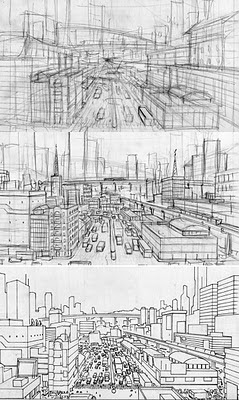
Cityscape: Finished Product

Image
Click on the image to enlarge. Rough drawing can be found in a previous post.

Drawing Process: Some Sort of a Manila

Image
Click on the image to enlarge. It's still unfinished.

"Pee" sized solution to fuel?

Fill'er up with weewee. We were treated years ago to news of a Filipino who claimed to develop a car engine that could run on water. While that technology has never seen the commercial light in this day of hybrids and alternative fuels, one Ohio scientist claims to have developed the means to run cars using urine. The hydrogen in urine is reportedly easier to extract compared to the hydrogen in water, thus requires less energy. Read all about it on Wired.com . If this technology becomes commercially available, our jeepney drivers wouldn't have to pee against their tires--they can relieve themselves while filling up the fuel tank. Abdul-less 'Idol?' It's almost certain that American Idol's next season won't have sweet Paula Abdul. This is according to her new manager David Sonenberg. So if she won't be on AI...what else could she be doing? She may not be the best judge on the show, but she balances out Simon Cowell quite effectively. Read more on Newswe...

Beginning Stages

Image
I was lying in bed when I was inspired to do this--I was given instructions to simply depict a comic book creator. You'll soon find out where this will come out. But, for now, I just wanted to share a behind-the-scene peek of how I do things. (Click on the image to enlarge.)

Character in Setting: 1011 Ricaforte Street

Image
If there was one thing I learned while working for Real Living that I'm applying in comics is the idea of character in setting--that a place has a life of its own. That setting contributes significantly to the story experience by inviting a reader to immerse him or herself into the new world. If I had taken up architecture in UP during my college days, I'd think that my sense for setting would've then been developed. Setting has always been an important element when I make comics, ever since I started with Flashpoint in 1993, but a lot of it has been on the surface. I didn't study it extensively back then--as long as I gave my settings enough detail, it should be fine. But now, I'm more conscious of history, of design, of detail, of styling, of culture, just through my magazine work. Add to that my conversations with friends who were into interior decor and production design, and I consider myself forever changed as a comics creator. Whenever I'd go to Manila ...

Start Your Graphic Novel: Part 2

Phase 4: Outline Your Story In 12 panels That's right. 12 panels. These panels will serve as the barebones structure of your story. The following breakdown is roughly based on Joseph Campbell's mythical structure and Christopher Vogler's Hero's Journey. Add captions, thought balloons, or bits of dialogue to support the images. Panel 1: The Setup. Draw the "World," in which your story will take place. In that world, draw your main character doing what he normally does in that world. Panel 2: The Inciting Incident or Call to Adventure. In this panel, draw the situation that prompts the main character into contemplating his main objective. This is where the "ultimate goal" is first described. Panel 3: The Doubt. In this panel, draw the circumstance that would make your main character initially refuse to take action. Panel 4: The Decision. In this panel, draw a situation that ultimately compels the main character to pursue the objective. Panel 5: The S...

Start Your Graphic Novel This January!

If you want to make your own graphic novel, or at least a graphic "novella," there's no better time to start the ball rolling than this coming January. So that, by the time the next Komikon comes along, you'll have something to show. Where do you start? How do you go about it? While every creator has his or her own system, I've outlined a method below, one that I've contemplated on using but never got around to trying it out. Phase 1: Opening Up To Story Ideas January is about beginnings, so spend 31 days being an active sponge. The objective of this month is to write down every idea that comes your way. You have to be actively looking for story ideas--reading newspapers and magazines, watching the news, surfing the net, even listening to friends--and jotting them down in an idea notebook. The ideas don't have to gel at first, and they don't have to be stories in themselves. They can be quotes, a flash of insight, a cool concept, a reflection, a memory...